
Building Confidence Through Experiential Learning
Fall 2025 Internship Report
Written by: Grace Conde, Assistant Director of Experiential Learning | Reviewed by Hannah Su Hepler, Director of Career Development
The objective of this report is to summarize the experience of Chatham interns over the course of the Fall 2025 semester, as well as to analyze the experience of the employers and intern sites to determine the success of the internship program in preparing students for careers after graduation.
Data Analysis
Data was collected through final evaluations from interns and their respective supervisors. Their supervisors were asked to rate their intern on a scale of 1-5 with 5 being the most competent. The core competencies evaluated in this report are Communication, Critical Thinking, Leadership, Professionalism, Teamwork, and Technology. These competencies come from the National Association of Colleges and Employers (NACE), which identifies the essential skills, behaviors, and attributes that students need to succeed in the workplace. NACE defines these competencies to help guide both student development and employer expectations, ensuring that graduates are prepared to contribute effectively in professional settings.
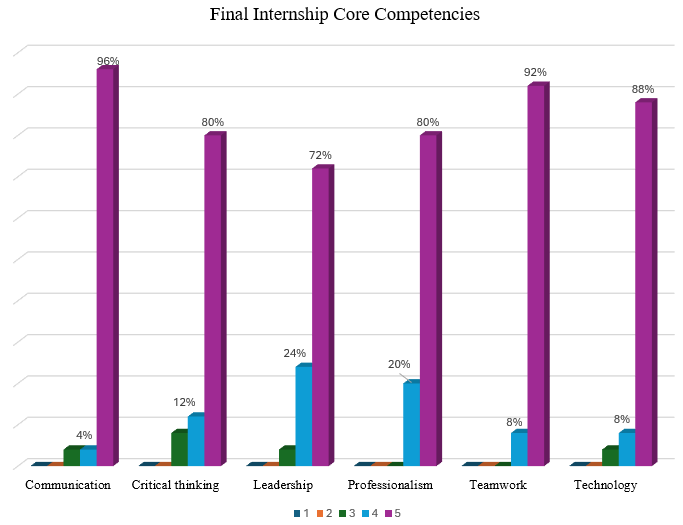
Final Evaluation Core Competencies
Supervisors rated their students the highest in Communication with 96% of supervisors giving their intern a rating of 5, indicating excellent communication skills in professional environments. Teamwork and Technology followed respectively; 92% of supervisors rated students a 5 in Teamwork and 88% rated their intern a 5 in Technology. 72% of students were given a 5 for leadership. This reflects strong emerging leadership skills, with room for growth relative to other competencies. Critical thinking and Professionalism were both given a rating of 5 to 80% of interns this semester, demonstrating supervisors see interns meeting or exceeding their workplace expectations.
This graph overall shows strong performance and competencies largely in the 4-5 range, with 5 being the most common rating across all categories. Furthermore, very few supervisors rated their interns below 3 for any of the core competencies, indicating a consistent baseline of satisfactory performance from Chatham interns.
This data continues to affirm that Chatham interns are professional and consistent in their work, with teamwork, communication, and professionalism emerging as particular strengths. Critical thinking and leadership, while still strong, show slightly more distribution with the supervisor ratings, indicating a potential to focus on those skillsets with workshops or partnerships with faculty.
What did students gain?
As part of final evaluations, students were asked about their accomplishments during the course of their internship. They were given the chance to leave any feedback about their site, and to share what they felt was their biggest accomplishment over the course of their internship.
One of our Fall interns completed their internship this semester with the Carnegie Museums, working specifically with a Curatorial Assistant. They noted that their “…greatest accomplishment is the connections I have made both within Phipps and with institutions outside of Phipps. My mentors stuck by my side through every task I was given but also gave me room to learn and grow. I was able to cater my internship to exactly the areas that interested me and would help me the most in my career. I am excited to have the opportunity to return to this position in the Spring!”
Another student completed their internship at the Pittsburgh public radio station WESA 90.5. They noted how their internship “prepared me well for working in a fast-paced professional newsroom. The learning curve was steep and the work was hard, but it was extremely rewarding contributing to the Pittsburgh community”.
A third student interned at McKeesport Regional History & Heritage Center and remarked that their position was “… a stellar opportunity to learn and practice particular skillsets. Over the course of the internship, not only will you get the opportunity to work with wonderful, knowledgeable individuals, but you will get to work on projects that connect with your personal interests and goals…. This experience helped me greatly in entering my desired career field”.
In addition to these individual experiences, many interns highlighted how their internships helped them build confidence, clarify their own career goals, and apply theoretical classroom knowledge to real-world professional environments. Across sites, interns reported feeling more prepared for the expectations and requirements of the workforce and more connected to professionals in their desired field or areas of specialization.
Trends to share with employers
To better understand how students are securing internships and how employers are supporting their development, we reviewed site reports and student evaluations from the Fall semester. This revealed that 60% of Fall internships this semester were a result of students reaching out directly to a company or employer. This suggests that students are motivated to seek opportunities proactively and that employers may benefit from making their points of contact and application processes more visible.
Meanwhile, another 12% of internships this semester originated from Handshake, and another 24% of Fall internships were facilitated through Chatham departments and faculty. The remaining 4% of internships this semester were a result of alumni connection. This data affirms the value of maintaining clear communication between departments, as well as continuing to promote the use of Handshake to students and employers.
Additional data reveals that 53% of internship sites this semester reported that this was their first time hosting a Chatham intern, and 92% reported that they would host another Chatham intern in the future, showing clear potential for long-term partnerships to grow from these initial experiences.
The data on student outcomes further demonstrates the quality of these partnerships. With 81% of students recommending their internship site, employers are offering environments that students view positively. Most notably, 96% of interns completed all learning objectives outlined in their Internship Learning Agreement, underscoring how effectively sites support student growth and professional development. Together, these metrics highlight the strong impact employers have on student success and the value of continuing to expand internship offerings and employer partnerships.
Feedback from Site Supervisors
Site supervisors also provided valuable insight into the growth and performance of Chatham interns throughout the semester. Their comments highlight not only the skills students brought into their roles, but also the development they demonstrated over time and the positive impact they had on their organizations.
Supervisors consistently noted strong work ethic, professionalism, and adaptability. One supervisor shared that “With the short amount of time, [student] has spent at the farm she has shown she works great while working on a team or by herself, there is a great attitude towards the job. Great at following instructions and asking questions”.
Another supervisor remarked “[Student] is the trailblazer! Based on her performance, we look forward to the opportunity of hosting more Chatham interns down the road. Thank you!”
A third shared “[Student] brought fresh perspective, enthusiasm, and a strong willingness to learn. The program is well-structured, and we appreciated the professionalism and preparedness she came in with. We would happily host a Chatham intern again in the future.”
These testimonials reflect the high regard supervisors have for Chatham interns and reinforce the program’s impact on both student development and employer satisfaction.
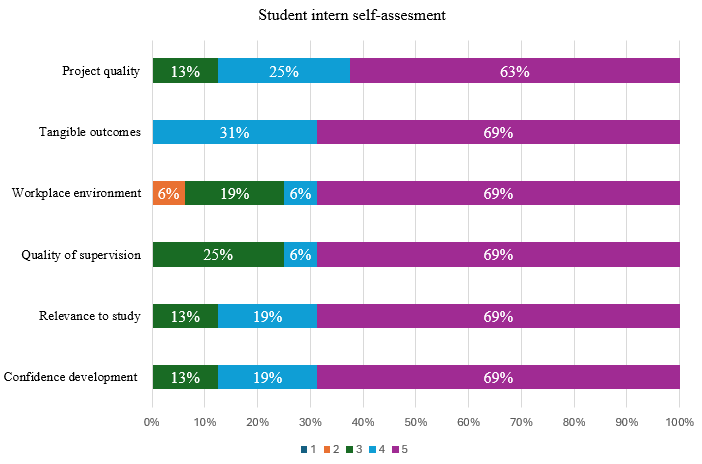
Student intern self-assessment
Student Self-Assessment
As part of the final evaluation, students were asked to rate their experience over the course of their internship. There are six categories students are asked to assess:
1) Project Quality: Were projects challenging and rewarding over the course of the internship
2) Tangible outcomes: Did their internship result in tangible examples of their work
3) Workplace environment: Was the workplace pleasant and respectful
4) Quality of supervision: Was the supervision supportive during internship
5) Relevance to study: Was the internship relevant to their major at Chatham
6) Confidence development: Did the student improve their confidence during their internship
The student self-assessment data shows exceptionally strong outcomes across all six measured areas. The majority of students rated their experience at the highest level (5), indicating that interns felt challenged, supported, and well-placed in their positions.
For project quality, 63% of students rated their experience as 5, with 25% rating it a 4 and 13%, giving a rating of 3. This data reveals students felt their projects were meaningful, challenging, and rewarding, and suggests alignment between project assignments and student’s learning goals and objectives.
Tangible outcomes received a 69% rating of 5, and 31% of students rated it as 4. This data, as well as the fact that no students rated it below a 4, demonstrates that students produced work over the course of their internship they can use in future portfolios, resumes, and interviews.
Workplace environment was rated as 5 by 69% of students, with 19% rating it a 4 and 6% rating it a 3. A very small number, 6%, rated it as 2. Students generally experienced positive, respectful, and inclusive work environments, with a few isolated experiences where communication or environment could be strengthened.
Quality of supervision received a rating of 5 from 69% of interns, with 6% giving a 4 and 25% giving a 3. Most students felt highly supported by their supervisors, though a notable percentage rated supervision as “average.” This may highlight variation in how structured or consistent supervisory guidance is across sites.
Relevance to study was rated a 5 by 69% of students, a 4 by 19% of students, and the remaining 13% of students rated it a 3. The majority saw a strong connection between their academic program and their internship tasks. A small portion felt their internship was less directly tied to their major, suggesting some students may benefit from clearer alignment with academic goals.
This data suggests a high standard of success within the internship program, and that interns are satisfied with their experience and resulting knowledge and accomplishments. A few differing answers within some sections, specifically Workplace Environment and Quality of Supervision, suggests there could be more guidance for supervisors on how to structure hosting a Chatham intern to ensure the most positive experience.
Conclusion
The Fall 2025 internship program at Chatham University continues to demonstrate strong success for both students and employers. Quantitative data from supervisor evaluations show that interns consistently performed at high levels across the measured competencies, with Communication, Teamwork, and Technology emerging as particular strengths. Student self-assessments reinforce these findings, highlighting meaningful experiences, supportive supervision, and clear connections to their academic areas of study. Furthermore, feedback from both students and supervisors underscores the professional growth, confidence, and real-world skill development that results from their internship.
Chatham interns reported gaining valuable experience, building professional networks, and clarifying career goals over the course of their internship. In addition, employers expressed satisfaction with interns’ contributions and a willingness to host future Chatham interns. These findings affirm the effectiveness of the internship program in preparing students for post-graduation and continues to strengthen connections between classroom learning and real-world experience.